
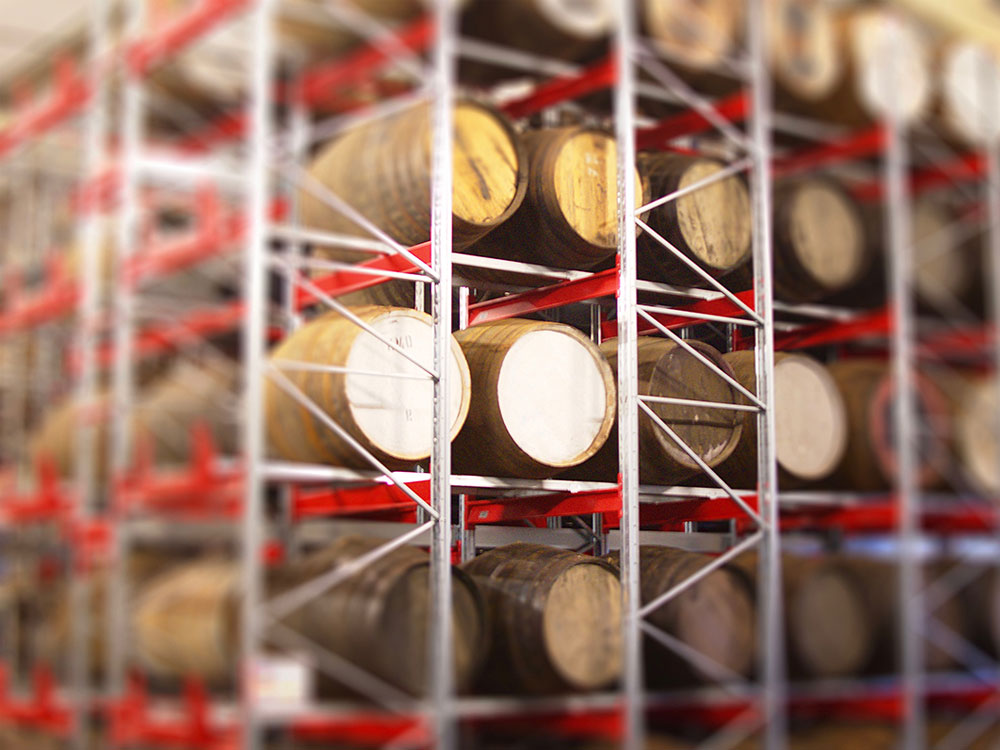
The honest answer is that it all depends.
There are a number of factors that will determine whether you can store more casks in a warehouse using racking as opposed to palletising, all of which will have a bearing on the capacity and practicality of each approach. These include; cask types, the contents of the casks, the length of time the casks will be stored, the internal dimensions of the warehouse and the condition of the floor.
The size of the casks and their contents will have a major bearing on how high the pallets can be stacked. Larger casks obviously weigh more and therefore can cause damage to casks when they are stacked high. This same problem can also mean distillers are less willing to stack pallets of casks containing premium whisky due to the risk of damage and therefore cost of leakage.
The internal dimensions of the warehouse will clearly also have a major bearing on the number of casks that can be stored, with higher buildings being naturally more suited to racking as it can be designed to take advantage of the full available height.
In addition, the condition of the floor and the condition of the pallets will also have a major influence on the number of casks that can be stored.
For example, in situations where the warehouse floor is anything less than perfectly smooth and where older, possibly damaged pallets are being used, the height at which pallets can be stored is severely limited due to the safety of having to shim pallets to ensure they are level and balanced.
Whatever your warehouse design and layout, our design team can work with you, using our Max the Cube approach, to show you the various options and alternatives available, allowing you to determine the solution which provides the best return on investment.